
Status: Closed | Framework: Mean Reversion / Range Rotation
Portfolio Execution Update: May 27, 2026 (11:45 AM)
In tandem with our exit in SanDisk (SNDK) this morning, our system has executed a tactical sale to close out our core long position in Seagate Technology (STX) at approximately 11:45 AM.
While Seagate’s individual price action technically remains stronger than SanDisk’s on a relative basis, these two hardware setups have moved entirely in lockstep throughout this entire cycle. Because group correlation is highly synchronized in this sector right now, the sudden structural shift and institutional selling observed in SanDisk served as a direct leading indicator for how we chose to manage our Seagate exposure.
Technical Logic: Selling Above Target to Prevent Range Reversion
Our initial technical target for this campaign was 841, which represented the major pivotal point high printed on May 11. Today, Seagate successfully cleared that level, and our system executed the sell route at 857—capturing an exit above our original target.
When an asset breaks out to new highs, the ideal scenario is to let the trend run. However, given the broader market environment, capital preservation must take priority. We are seeing notable weakness across the major equity indices—specifically the S&P 500 and the NASDAQ 100—alongside an uncharacteristic drop in market leaders like NVIDIA.
Because of this broader index pressure, there is an increased probability that the tech sector experiences a coordinated pullback over the coming days or weeks. Even though STX is currently holding above its May 11 breakout high, a broader sector correction would likely drag the stock right back into its previous balance area. To prevent giving back our open gains during a potential range reversion, we determined that taking profits at these elevated prices was the most disciplined choice.
Campaign Summary Log
We initiated this tactical campaign on May 20 with an entry fill at 747. Today, we locked in the position and closed the remaining exposure at 857.
By securing a 110-point gain on this position, we have successfully insulated our fund equity from near-term sector volatility. We will continue to track the hardware group closely to see if value formally accepts at these higher levels or if a deeper reversion presents a lower risk-defined re-entry.
Update May 26, 2026: Breaking new highs.
Execution Matrix
- 🟢 Position Entry: $747.02
- 🎯 Primary Target: $841.00 (Range High Resistance)
- 🛑 Hard Technical Stop: $724.15 (Range Invalidation Floor)
- ⚖️ Asymmetry (R:R Ratio): 4.11 : 1 (Risking $22.87 to capture $93.98)
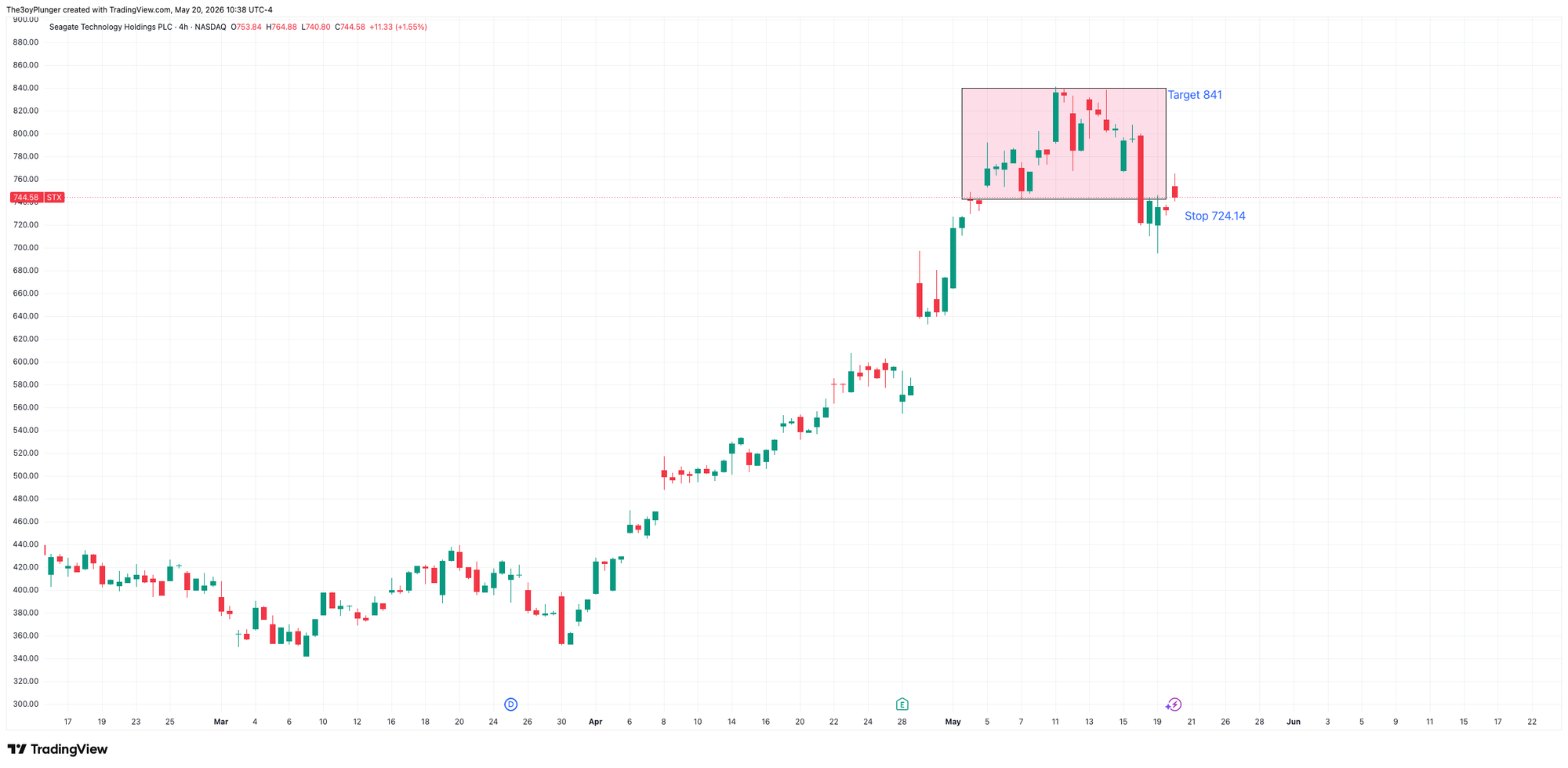
Structural Analysis & Trade Thesis
Market Profile Research has initiated a new long position in Seagate Technology ($STX). The asset is establishing a high-probability reversion to range highs after completing a multi-week test of its primary macro balance area floor. Responsive institutional demand has rotated into the structure, confirming structural support and signaling a value rotation back up through the asset's core liquidity nodes.
Our execution at $747.02 positions capital near the lower boundary of this multi-quarter range. Following standard Auction Market Theory, when a well-defined balance area floor is successfully defended, the path of least resistance shifts toward a complete rotation across the value area. Our objective of $841.00 targets this historical range ceiling, where overhead supply is expected to cluster.
Risk Mitigation & Capital Preservation Protocols
To preserve portfolio integrity against a structural breakdown of the current balance architecture, execution is bound by these rules:
- Defensive Range Invalidation: Our hard protective stop is locked at $724.15. This baseline sits directly below the range floor where institutional absorption occurred. Acceptance below this value node cleanly invalidates our range-reversion thesis and triggers an automatic defensive liquidation.
- Trade Management: Given the strict 4.11x reward-to-risk asymmetry, we will remain passive and allow the rotation to develop. No tactical adjustments to parameters will be enforced unless the tape signals a definitive failure of range structure.